
Summary
Photoplethysmography (PPG) is the optical sensing technology behind almost every wearable vital-sign sensor, but its light-absorption principle depends on adequate pulsatile blood volume at the measurement site. At anatomical locations with characteristically low peripheral perfusion ‘most notably the toes and the sole of the foot’ PPG amplitude is well known to become weak and unreliable, a long-standing obstacle to continuous monitoring at sites that matter most for diabetic-foot and peripheral-vascular care.
Praxa Sense’s ALIS® (Absorption & Laser Interference Sensor) adds a second physiological dimension to conventional PPG: blood-flow dynamics. Using speckle plethysmography (SPG) ‘in which a miniature coherent laser and image sensor capture dynamic speckle patterns generated by blood flow beneath the skin’ ALIS® simultaneously extracts a PPG-equivalent blood-volume signal and a Blood Flow Index (BFi) from a single optical measurement.
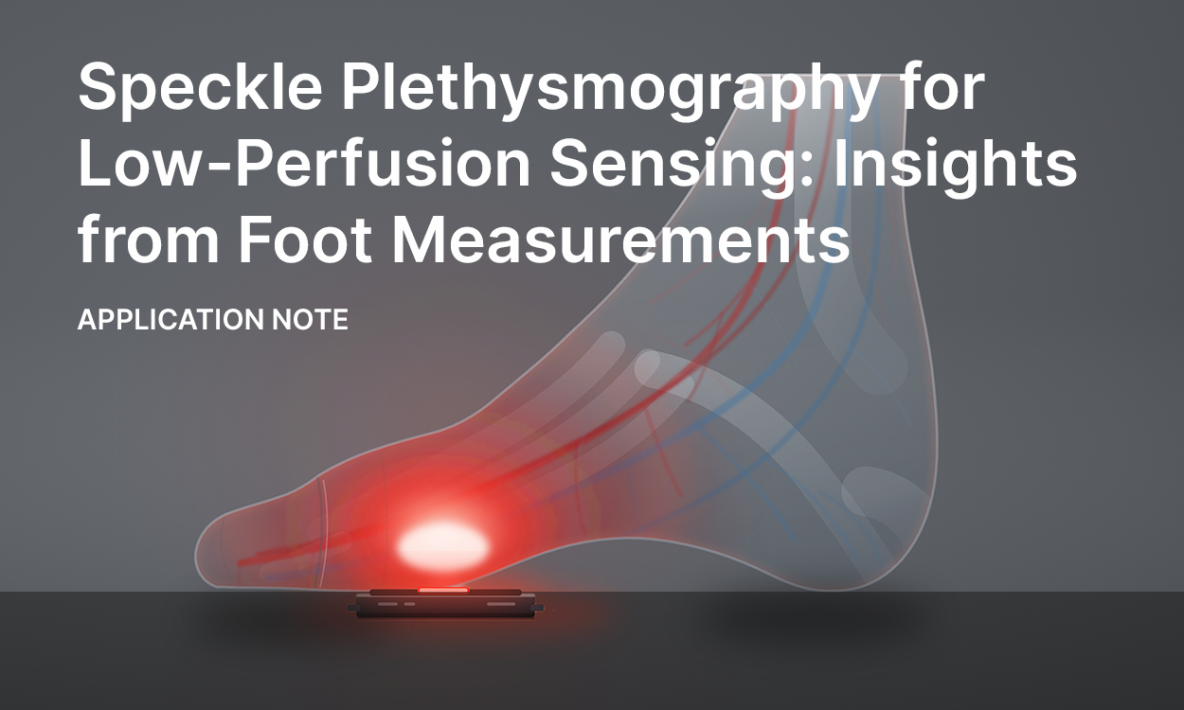
In an exploratory feasibility study, an ALIS® prototype was positioned beneath the ball of the foot in an approximately 1-inch opening in a modified weighing scale. The sensor was supported within the opening by a simple 3D-printed spring suspension, allowing measurements to be taken from three healthy volunteers while standing on the scale. Across nine measurement sessions, at two wavelengths and on different days, ALIS® consistently produced clean, high-modulation BFi waveforms with clearly resolved systolic features, at a site where reflective PPG is classically expected to perform poorly.
Speckle Plethysmography for Low-Perfusion Sensing: Insights from Foot Measurements
Send download link to: